 FlaskConnect™
Home › Apparatus gallery › Total synthesis scheme (PGF₂α)
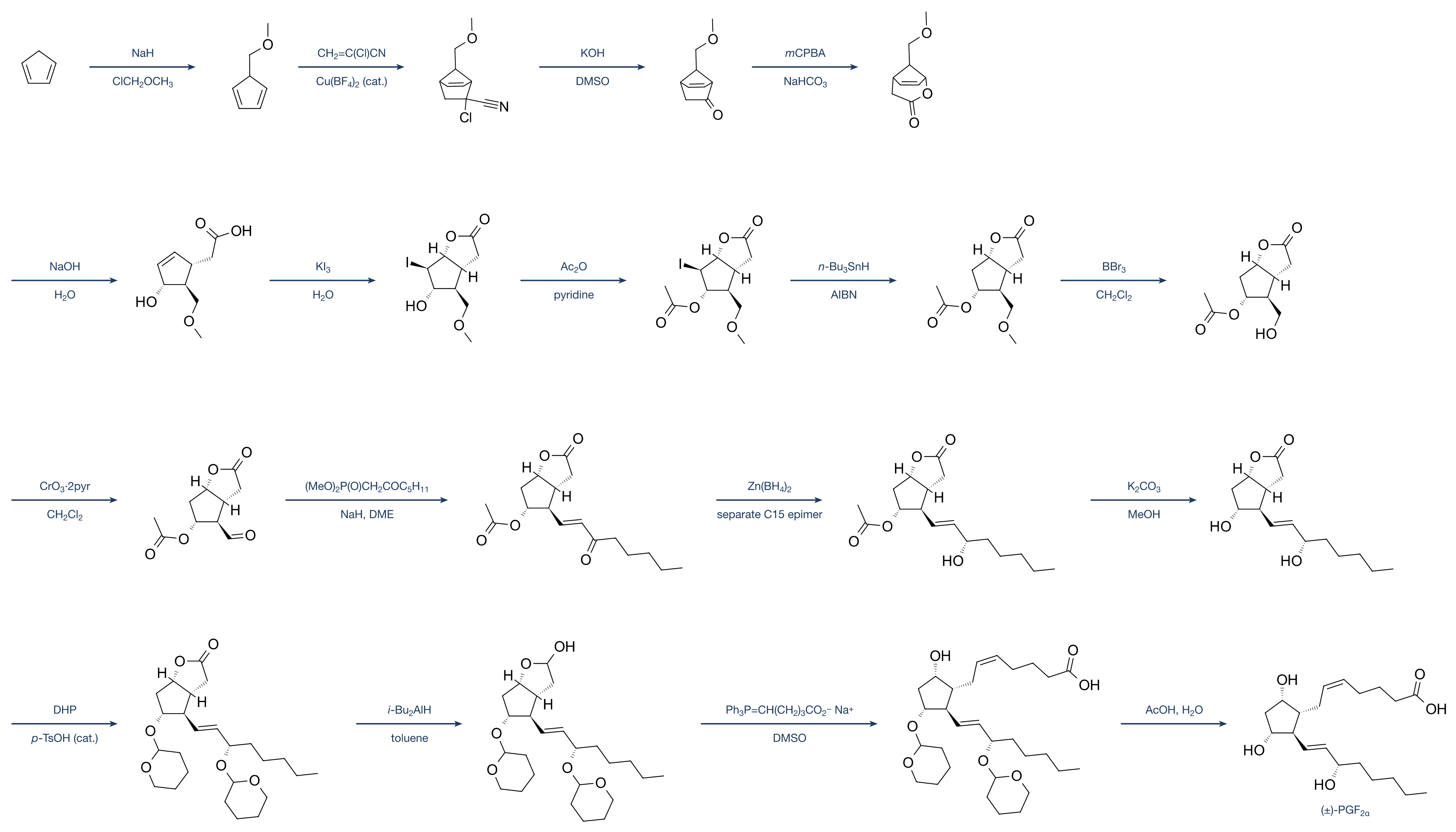
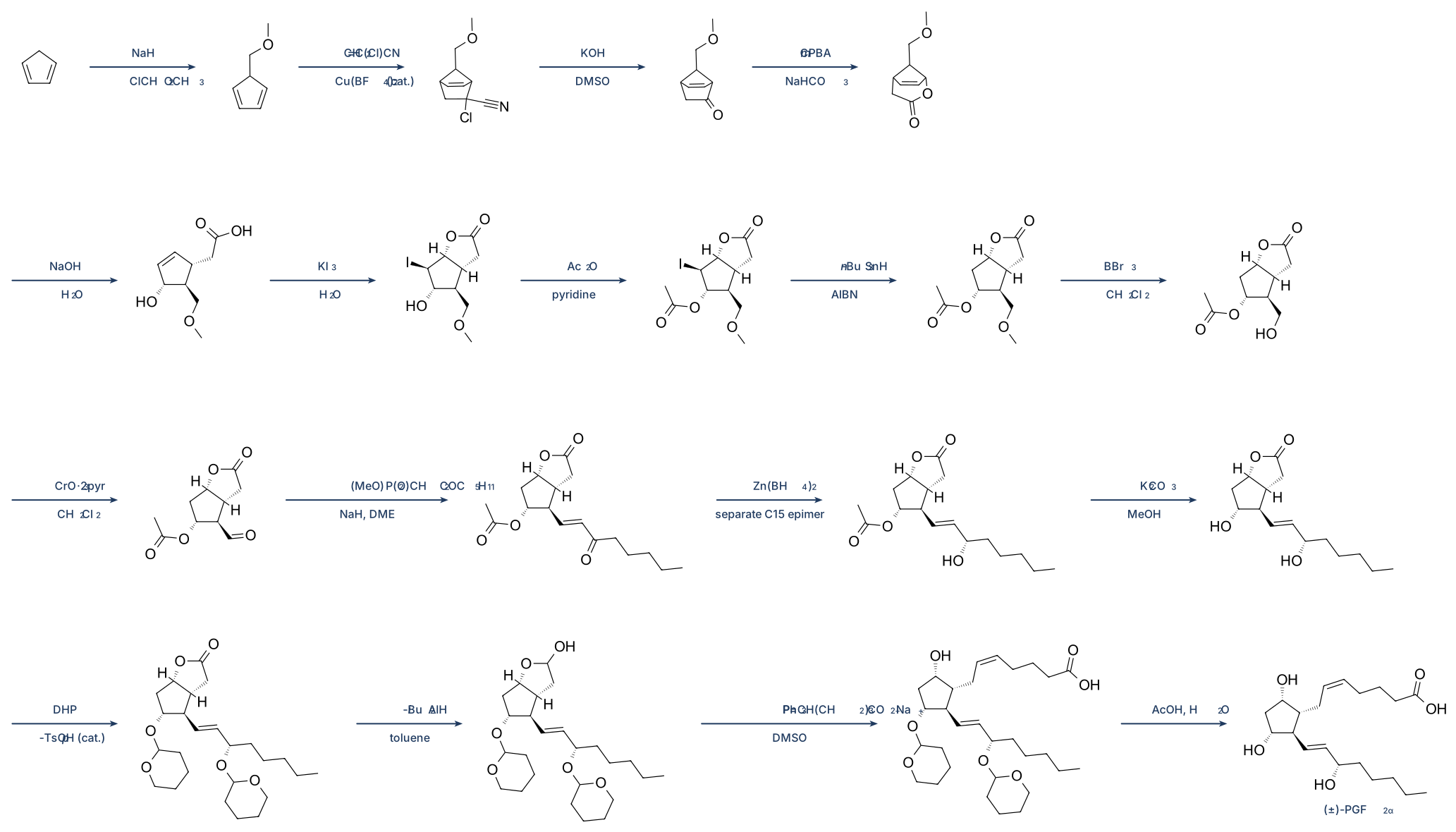
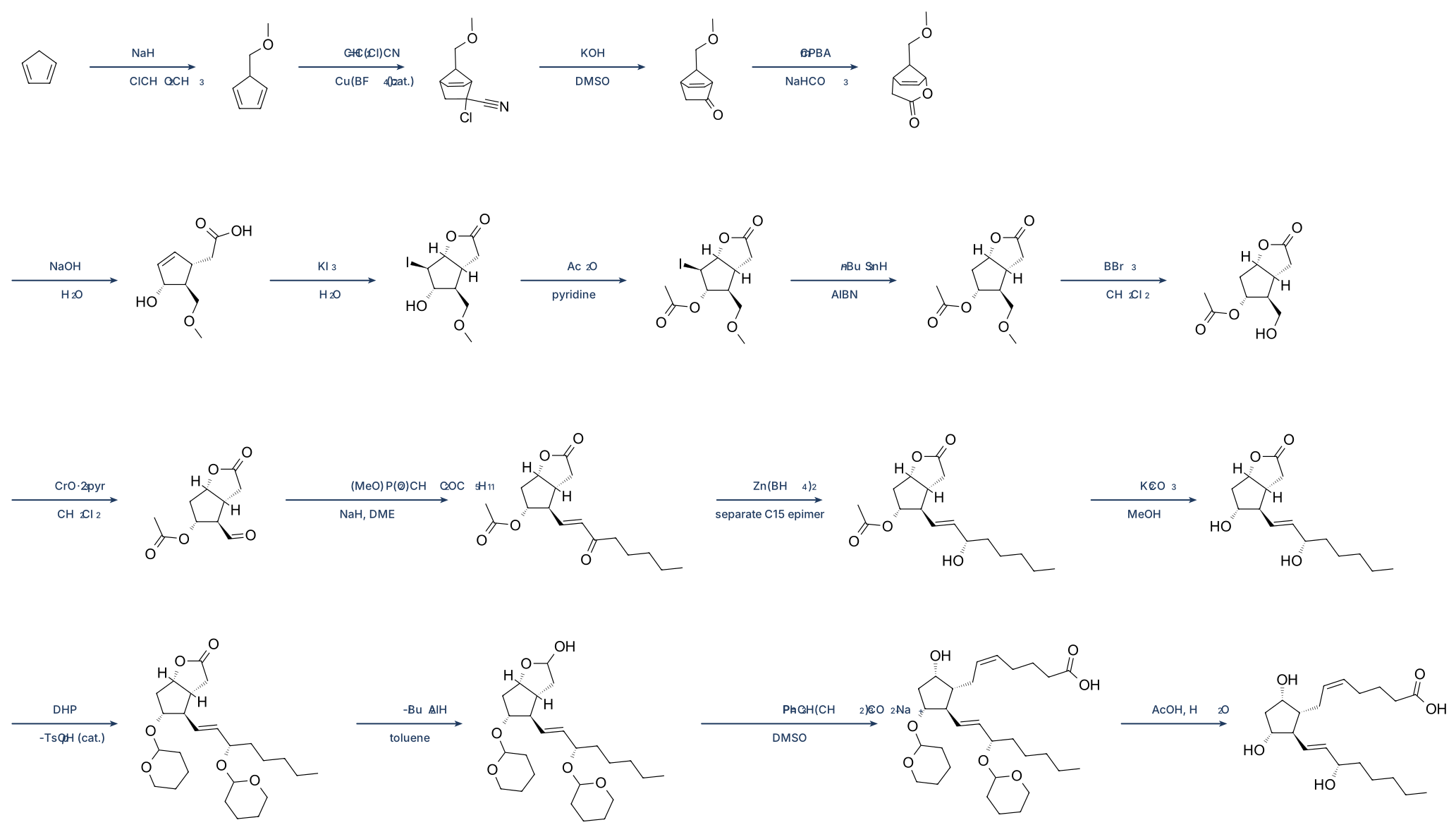
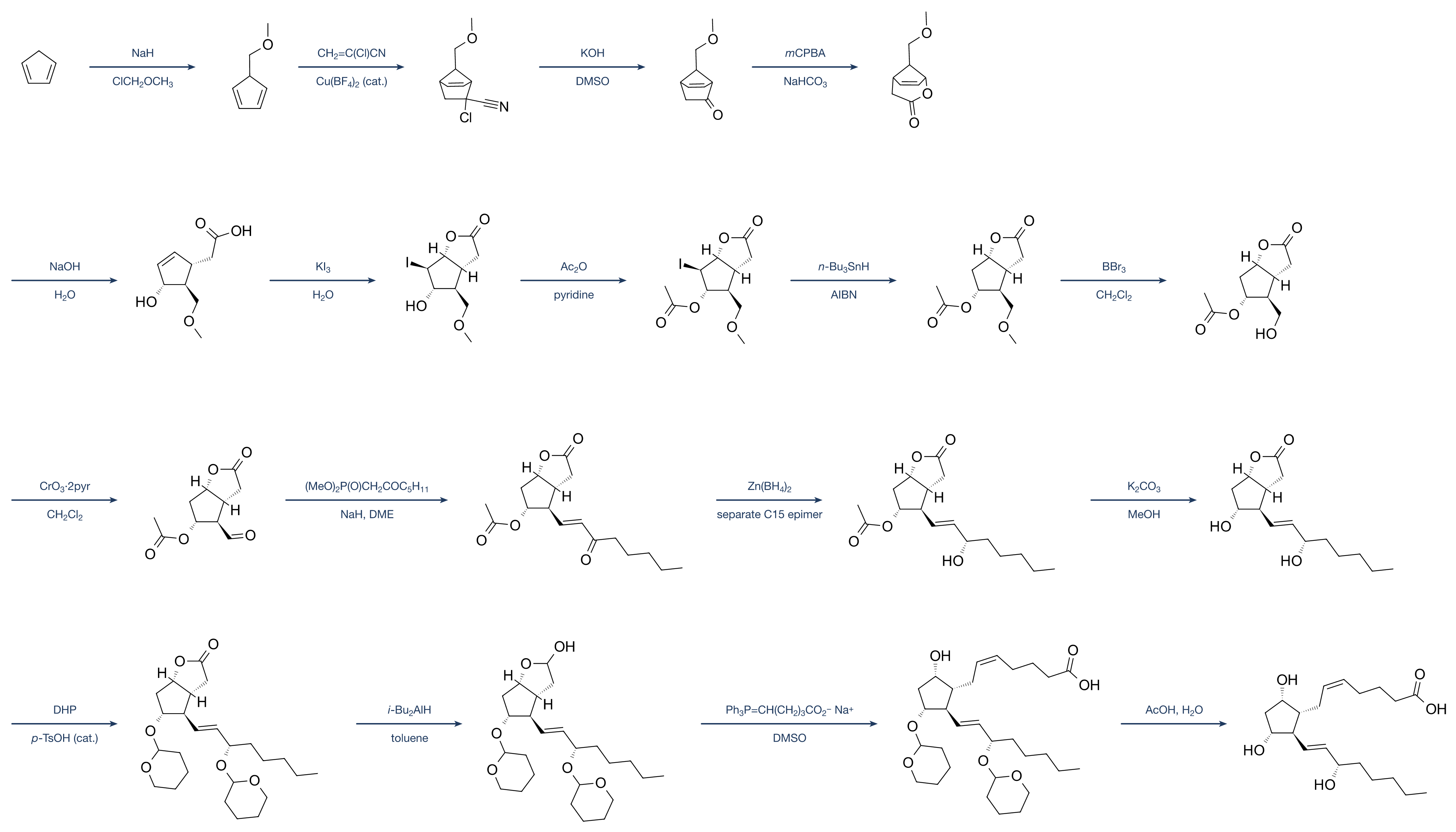
Multistep Reaction Scheme: Total Synthesis of Prostaglandin F₂α (Corey, 1969)
E. J. Corey's total synthesis of prostaglandin F₂α (1969), drawn as a 17-step reaction scheme. Each intermediate was drawn by copying the previous structure and editing it.
Free to use without attribution in lab reports, theses, teaching materials, slides, supporting information and on the web, including modified and commercial use. Released under CC0 1.0 (public domain dedication). A mention of “made with FlaskConnect” is appreciated but not required.
Features used in this figure
- Structure editor (draw, eraser, elements, rings, bond order)
- Copy and paste (edit the previous structure)
- Wedges, hashes and perspective drawings of bicyclic rings
- Text above and below arrows (subscripts, superscripts and italics with buttons)
- Add a whole six-membered ring (THP) with the ring tool
How to draw it in FlaskConnect
- Draw the first structure (place a ring, click bonds to make double bonds).
- In the Apparatus tab, select the structure, copy and paste it, and drag the copy to the next position.
- Edit it in the Structure tab: erase, drag from an atom to extend, use the element buttons for O or I, click a bond for a double bond, and use Front/Back for stereochemistry.
- Where the skeleton changes a lot (the Diels–Alder adduct, the bicyclic lactone), draw it fresh.
- Draw a reaction arrow and type reagents above and conditions below, in place.
- Finally, caption the product (±)-PGF₂α.
Notation tips
- The synthesis was racemic (dl), so the product is written (±)-PGF₂α; the wedges and hashes show relative configuration.
- The bicyclic intermediates (Diels–Alder adduct, ketone, lactone) show their stereochemistry through the perspective drawing.
- In the iodolactonization, iodine and the lactone oxygen add to opposite faces of the ring (anti addition).
- The reduction in step ⑫ gives both C15 epimers; the separated one is shown.
- THP protection creates a new stereocenter in each THP group, giving a mixture of diastereomers (not shown in the figure).
- The Wittig reaction (non-stabilized ylide) makes the C5 double bond cis (Z); the Horner–Wadsworth–Emmons reaction in step ⑪ makes C13 trans (E).
Source: E. J. Corey, N. M. Weinshenker, T. K. Schaaf, W. Huber, J. Am. Chem. Soc. 1969, 91, 5675–5677. The figure was drawn anew in FlaskConnect and is not a reproduction of the original figures. Reagents follow the original paper and standard textbooks; some conditions such as temperatures are omitted.
Watch it built
Drawing this figure in FlaskConnect (with narration).
Draw this in the app
This figure was drawn in FlaskConnect. Call up structures by name or SMILES, and add lone pairs, curved arrows and arrow text (subscripts and superscripts with buttons) in place. Drawing structures and schemes is Pro (US$3.99/month, first month free, or US$39.99 once); apparatus drawing and export are free.